
(Note: the following does not constitute legal advice. Regulations in your locality may be different. This information is simply to prompt you to be sure you are compliant with the requirements of your locality.)
Opening a retail store is an exciting milestone, but it also comes with an often‑overwhelming web of government regulations and licensing requirements. From permits and tax obligations to employment laws and accessibility rules, compliance is not optional—and missteps can result in fines, delays, or even forced closure.
Business Licenses and Permits
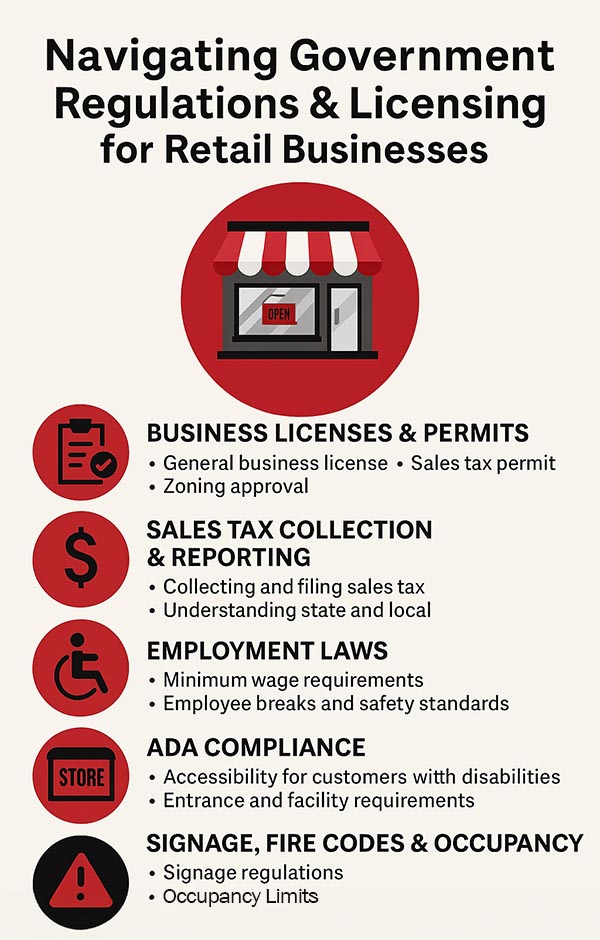
(Image generated in CoPilot A.I.)
At minimum, retailers typically require a general business license. Many jurisdictions also require a sales tax permit (aka seller’s permit or resale license) and industry‑specific permits—for tobacco, alcohol, food, cosmetics, or firearms sales.
Zoning permits: Your location must be zoned for commercial use, and sometimes for your retail category.
Sales Tax Collection and Reporting
If your store sells taxable goods, you are responsible for collecting the correct tax rate at the point of sale and remitting it to the appropriate tax authority (The U.S. states that do not have a state sales tax are Alaska, Delaware, Montana, New Hampshire, and Oregon. However, some local jurisdictions within these states may impose their own sales taxes). Filing frequency may depend on your revenue volume.
Some states have expanded sales tax obligations based on economic nexus, meaning retailers may owe sales tax even without a physical presence if they exceed certain sales thresholds in that state (like if you sell online out of state).
Federal, State, and Local Differences
Retail regulation operates across multiple government levels, and each plays a distinct role.
Federal regulations cover employment standards, workplace safety, and accessibility through agencies like Department of Labor (DOL), Occupational Safety and Health Administration (OSHA), Fair Labor Standards Act (FLSA), and Equal Employment Opportunity Commission (EEOC).
States control sales tax rates, labor laws beyond federal minimums, licensing procedures, and health regulations. States may establish higher minimum wages or more generous employee leave policies.
Local governments regulate zoning, signage, fire safety, and occupancy limits. Local rules can vary dramatically from one municipality to another.
Click to Download a Retailer Compliance Checklist in Excel format to evaluate your compliance blind spots and track your progress.
ADA Compliance and Accessibility Requirements
The Americans with Disabilities Act (ADA) establishes minimum accessibility standards for retail businesses open to the public. Enforcement can include lawsuits initiated by customers. Retailers must provide accessible entrances, clear interior aisles, checkout counters at appropriate heights, accessible restrooms (if available to customers), and parking spaces with proper signage. When remodeling or leasing a space, retailers should assess ADA compliance early to avoid costly retrofits later. ADA compliance also extends to website design.
Signage, Fire Codes, and Occupancy Regulations
Even seemingly simple elements like signs and store layouts are often regulated. Fire codes regulate emergency exits, fire extinguishers, alarms, and sprinkler systems. Occupancy limits specify the maximum number of people allowed inside the store at one time.